
TL;DR: Your Quick Start Plan (Tonight)
- Do a 1-minute reset: 3 slow breath cycles, long exhales.
- Lay out tomorrow: clothes, backpack, lunch, alarm set.
- Pick one tiny action for the biggest worry (e.g., text a friend or draft a study step).
Back-to-school anxiety is common and valid; it’s your body reacting to change, not a personal failing.
Why You Feel This Way (and Why It’s Normal)
Big transitions flip on your body’s fight–flight–freeze system. That’s why hearts race, breathing quickens, and stomachs flutter. Knowing the biology helps you swap self-blame for strategies.
Step 1 — Name It to Tame It
Before you can tackle anxiety, you need to know what you’re up against. Naming your specific fears takes away their power and turns a big, vague worry into a smaller, manageable problem.
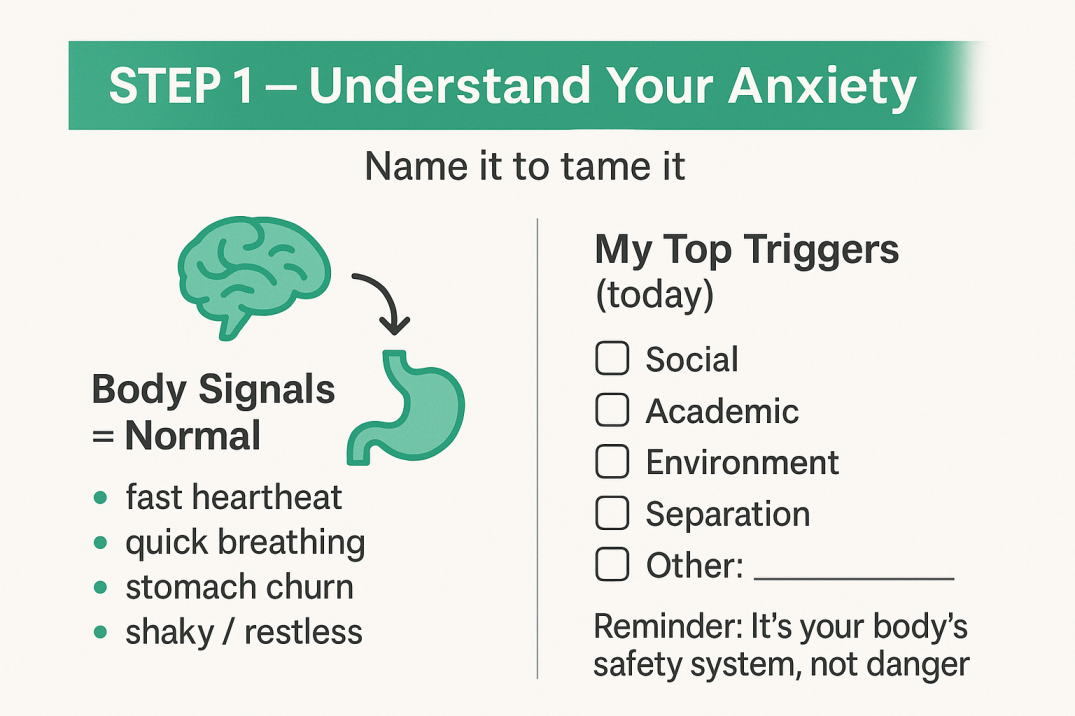
Why Your Body Feels So Weird
Ever wonder why anxiety makes your heart race or your stomach churn? It’s your body’s ancient “fight, flight, or freeze” response kicking in. When your brain senses a threat—whether it’s a real danger or an emotional one like speaking in class—it releases stress hormones like adrenaline and cortisol. This causes real, physical symptoms:
- A faster heartbeat to pump blood to your muscles.
- Rapid breathing to take in more oxygen.
- Stomachaches or nausea as your body conserves energy.
Your brain can’t always tell the difference between a true emergency and the fear of being judged. Knowing that your symptoms are a real biological reaction helps you stop blaming yourself and start working with your body.
Pinpointing Your Triggers
Your anxiety is unique. What specifically is fueling it? Common triggers include:
- Social Anxiety: The fear of being watched, judged, or embarrassed. This can include worrying about reconnecting with friends, making new ones, or being the target of bullying.
- Academic Anxiety: Pressure to get good grades, fear of failing a test, or dreading a presentation. This pressure can come from others, but often we are our own harshest critics.
- Environmental Anxiety: Stress about a new school, not knowing your way around, or a major change in routine. For some, news about school violence can also create a real fear for personal safety.
- Separation Anxiety: Most common in younger kids, the fear of being away from parents can persist for some students, especially after a long summer at home.
- Fears for Mature Students: Adults returning to school may worry about being “too old,” having rusty study skills, or how their new path will change their family life.
It’s also important to know the difference between normal jitters and a more serious anxiety issue. The key differences are intensity, duration, and impact. While jitters are mild and fade after the first week, a potential anxiety disorder involves intense, persistent feelings that get in the way of your life at school and home. If your experience feels more severe, know that your feelings are valid and deserve support.
Step 2 — Prepare Your Environment for a Calm Start
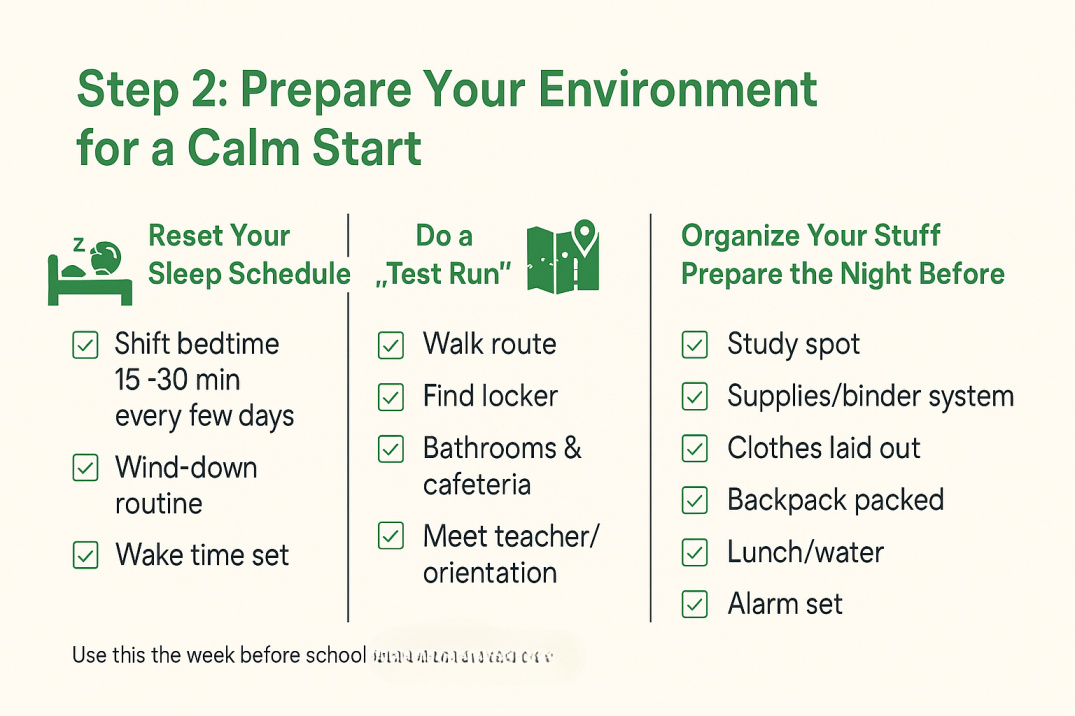
Anxiety thrives on chaos. One of the best ways to fight back is to make your world as predictable and organized as possible before the first bell rings.
- Reset Your Sleep Schedule: Sleep is critical for managing stress. Don’t wait until the night before school; start adjusting your bedtime and wake-up time by 15-30 minutes every few days, one to two weeks in advance. Create a “wind-down” ritual an hour before bed by turning off screens and doing something calm, like reading or listening to music.
- Do a “Test Run”: Familiarity beats fear. If you can, visit the school before classes start. Walk your route between classes, find your locker, and locate the bathrooms and cafeteria. Attend any orientation or “meet the teacher” event to make the people and places feel less intimidating.
- Organize Your Stuff: A calm space helps create a calm mind. Designate a quiet spot at home for studying. Get your supplies in order using a simple system, like a binder with dividers or separate notebooks for each class.
- Prepare the Night Before: This is a top-tier stress-reduction habit. Lay out your clothes, pack your backpack, and prepare your lunch the night before. It eliminates morning panic and helps you start the day with a sense of control.
Step 3 — Master In-the-Moment Calming Tools
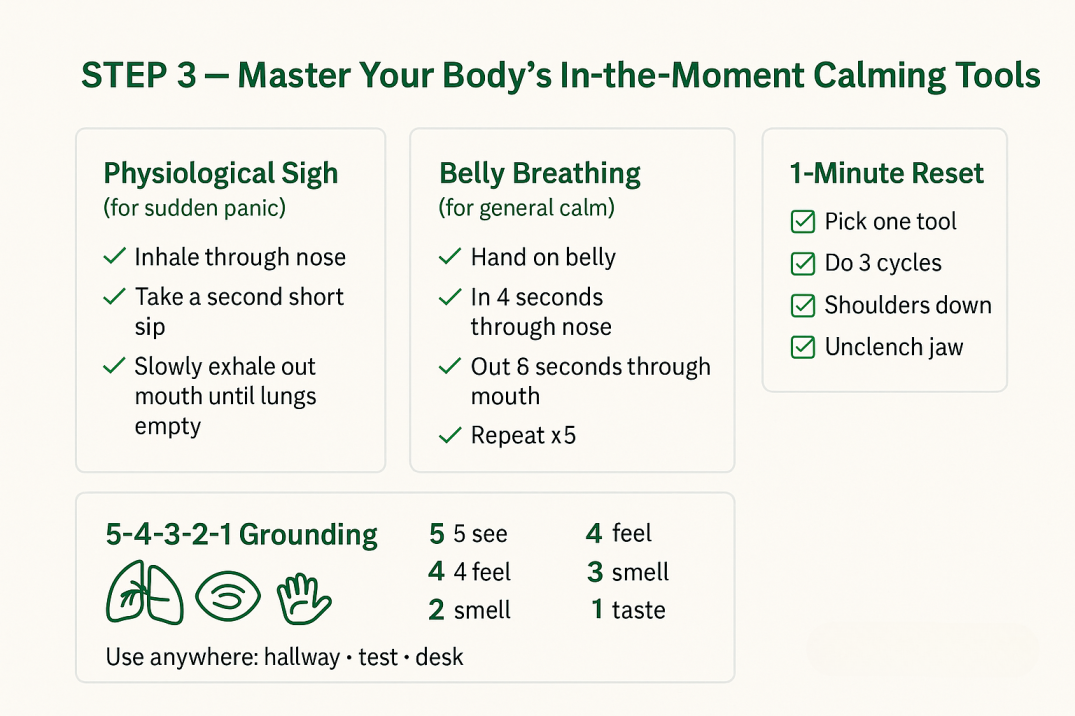
Even with perfect preparation, anxiety can spike. In those moments, you need a first-aid kit of techniques to calm your body and mind. Your most powerful tool is your breath. By consciously slowing your breathing, you send a direct message of safety to your brain, activating your body’s “rest and digest” system.
Here are three exercises to practice so they become automatic:
- The Physiological Sigh (For Sudden Panic): Research shows this is one of the fastest ways to calm down. Take a deep breath in through your nose, then take another short “sip” of air in. Finally, exhale slowly and completely through your mouth for as long as you can.
- Belly Breathing (For General Calm): Place one hand on your belly. Breathe in through your nose for a count of four, feeling your belly expand. Breathe out slowly through your mouth for a count of six. The long exhale is key.
- The 5-4-3-2-1 Grounding Technique (To Stop an Anxiety Spiral): This mindfulness exercise pulls you out of worried thoughts and into the present moment. Wherever you are, silently name:
- 5 things you can see.
- 4 things you can feel.
- 3 things you can hear.
- 2 things you can smell.
- 1 thing you can taste.
These tools can be used silently and discreetly anywhere, anytime—in a crowded hallway, during a test, or at your desk—giving you a secret toolkit to regain control.
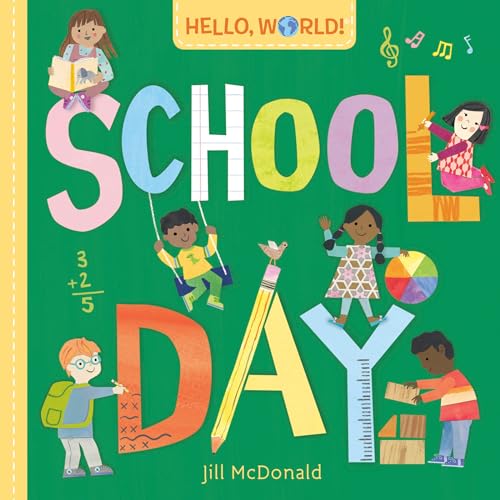


Step 4 — Reframe Anxious Thoughts
Anxiety is fueled by the negative stories we tell ourselves. The goal isn’t to stop these thoughts, but to stop automatically believing them. Think of your anxious thoughts as a “gremlin” on your shoulder that specializes in twisting reality.
Common anxious thoughts, or “cognitive distortions,” include:
- Catastrophizing: “If I fail this test, my life is ruined.”
- Mind Reading: “Everyone thinks I’m an idiot”.
- Fortune Telling: “I just know I’m going to mess this up.”
Use the “3 C’s” to challenge these thoughts:
- Catch It: The moment you feel anxious, ask, “What thought just went through my mind?” Simply notice it without judgment.
- Challenge It: Become a detective. Ask tough questions: Is this thought 100% true?. What’s the evidence against it? What’s a more realistic way to see this? What would I tell a friend who had this thought?
- Change It: Replace the anxious thought with the more balanced one you came up with. Instead of, “I’ll look like a fool if I ask a question,” try, “My learning is more important than what I imagine someone might think for a second.”
Journaling is another powerful way to get these thoughts out of your head and gain clarity.
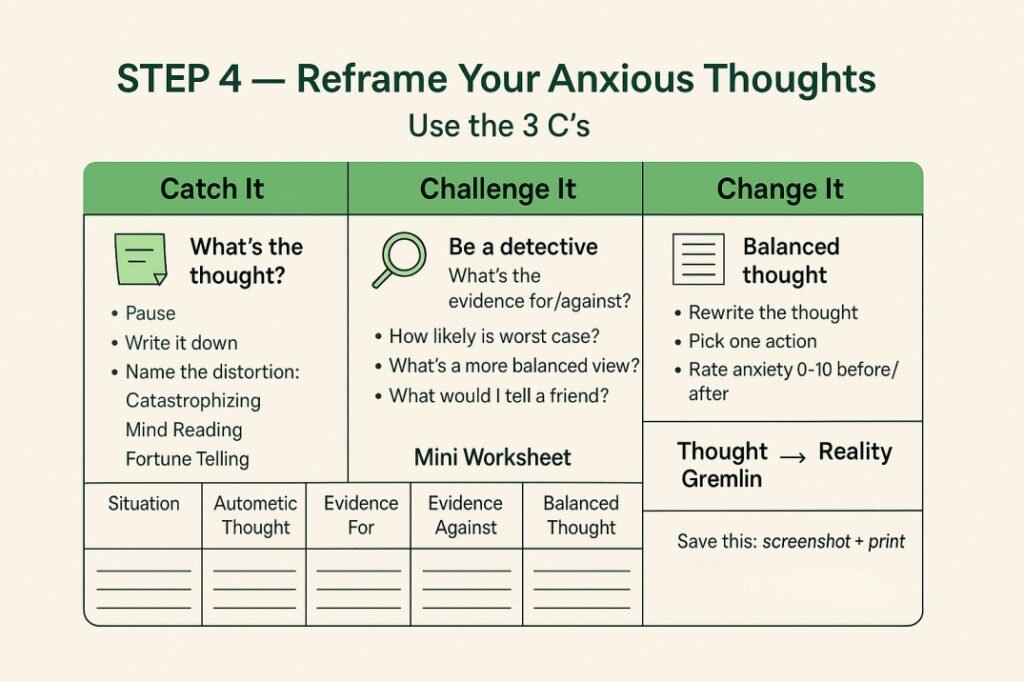
Step 5 — Navigate Your Social World with Confidence
For many, the social scene is the biggest source of anxiety. Here’s how to manage it.
- Make Connecting Easier: Break the ice before school starts with a simple text to a friend. To meet new people, use approachable body language (head up, phone away) and simple conversation starters like, “What did you think of the homework?”. Joining a club or sport is one of the best ways to find people with shared interests.
- Know a Friend Group from a Clique: Healthy friend groups are open, based on mutual respect, and make you feel good about yourself. Harmful cliques are exclusive, based on status, use gossip to make others feel inferior, and make you feel like you have to change to fit in. Recognizing the difference can empower you to seek out genuine connections.
- Adopt a “Dignity-First” Policy: Treat everyone with basic respect, even if you aren’t friends. This means avoiding whispering in front of others or ranking people by popularity. It’s a strategic way to lower the overall level of social conflict around you, which reduces your own anxiety.
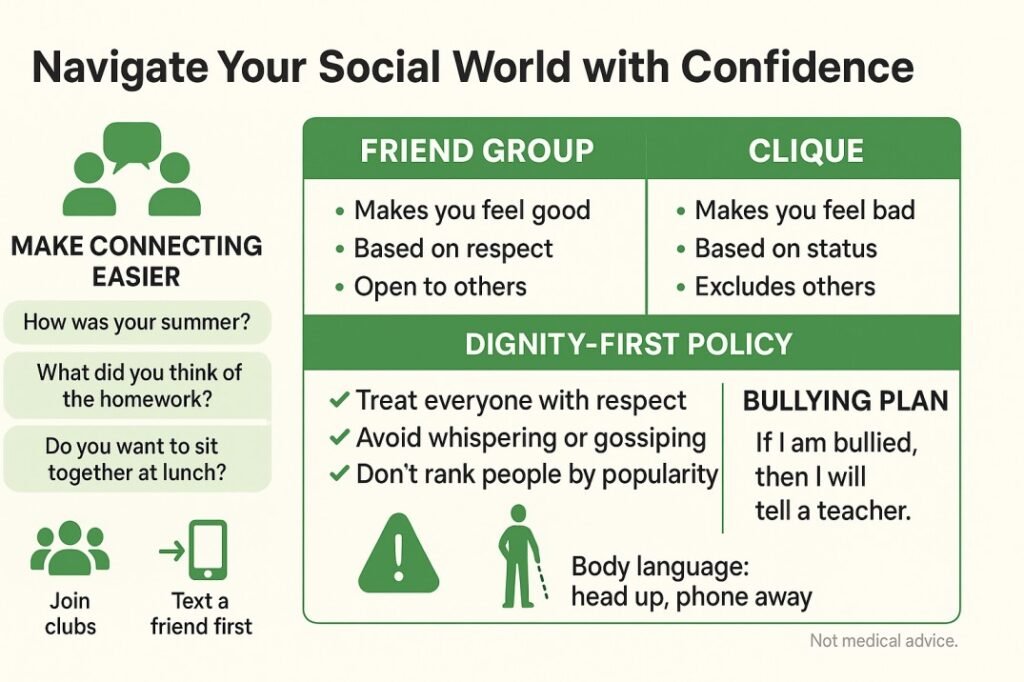
Step 6 — Conquer Academic Pressure (Without Burning Out)
The pressure to get good grades can feel crushing, but high achievement doesn’t have to cost you your mental health.
- Break the Comparison Trap: Your academic journey is your own. Focus on your personal goals and progress, not on how you measure up to your classmates.
- Break Down Big Projects: Staring at a huge assignment is paralyzing. Break it down into the smallest possible steps. Instead of “write history paper,” your first step is “find three sources”. Each tiny success builds momentum.
- Redefine Success: Relentless pressure can actually lead to worse results by causing burnout. Understand that rest is productive. Scheduling time for hobbies and friends is not lazy; it’s an essential strategy for academic success.


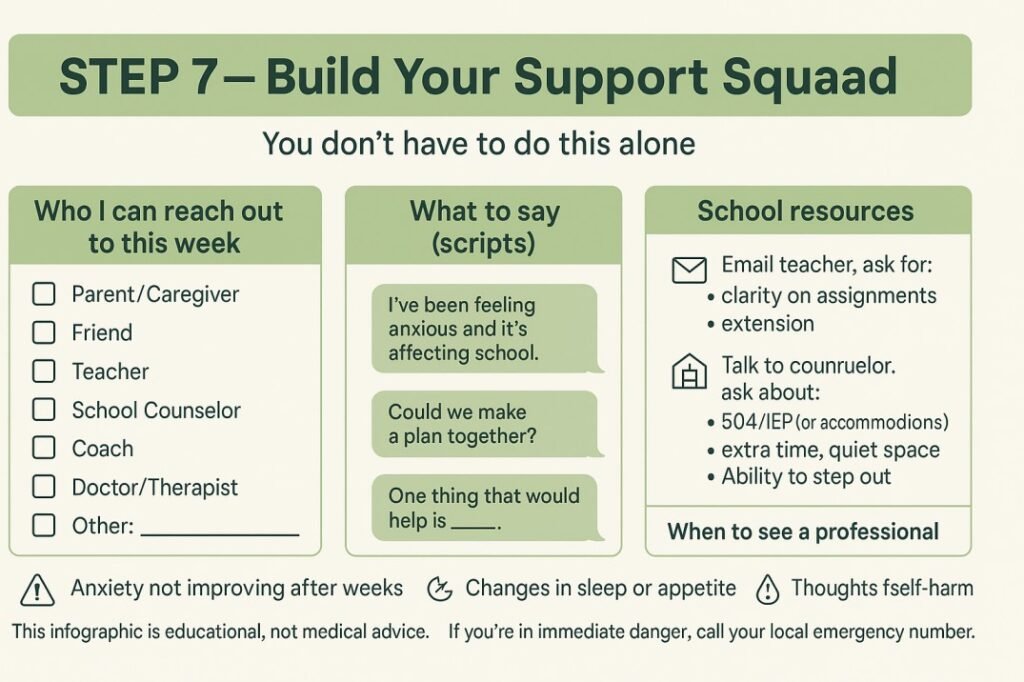
Step 7 — Build Your Support Squad
Trying to handle anxiety alone is exhausting. One of the bravest things you can do is ask for help.
- Talking to Parents or Caregivers: Choose a calm time and place. Use “I feel” statements like, “I feel really overwhelmed by my classes,” instead of accusations. Be specific about your worries. If they react with frustration, try to remember it often comes from a place of love and their own anxiety about seeing you in distress.
- Using School Resources: Teachers and counselors are there to help you. It’s a sign of strength to reach out. You can simply say, “I’ve been feeling anxious lately, and it’s making it hard to focus. Can you help?”. Counselors can provide confidential support and help you get accommodations, like extra time on tests, through a 504 Plan if needed.
- Knowing When to See a Professional: It’s time to seek professional help from a therapist if your anxiety is consistently disrupting your life, your symptoms are severe and long-lasting, you’re refusing to go to school, or you’re having any thoughts of harming yourself. This is a proactive and courageous step toward feeling better.
Safety Note
If you’re in immediate danger or thinking of self-harm, seek local emergency help right away. For general education on anxiety, see the NIMH: Anxiety Disorders resource: https://www.nimh.nih.gov/health/topics/anxiety-disorders
FAQs (Back-to-School Anxiety)
1) How do I know if this is “normal” back-to-school anxiety or something more?
Jitters usually fade after the first week. If worry is intense, lasts longer, and interferes with school/home life, it’s time to seek extra support.
2) What’s the fastest way to calm down before class?
Try the physiological sigh: inhale, quick top-up inhale, long slow exhale. Repeat 2–3 times.
3) I’m scared of asking questions and looking silly—what should I tell myself?
Use the 3 C’s. A balanced reframe might be: “My learning matters more than a momentary opinion.”
4) How can I make friends without feeling awkward?
Start small: send a text before school, use open body language, then join a club to meet people with similar interests.
5) I’m overwhelmed by a huge assignment. Where do I start?
Turn it into micro-steps: “find 3 sources,” “draft outline,” “write intro.” Momentum beats motivation.
6) When should I talk to a counselor or therapist?
When anxiety sticks around, gets severe, keeps you home from school, or brings self-harm thoughts. Help is strength.
Conclusion: You Are More Resilient Than You Think
The goal is not to eliminate anxiety forever—it’s a normal part of life. The goal is to build the unshakeable confidence that when it does show up, you have the skills to handle it. You know how to calm your body, challenge your thoughts, and find your people. You are more capable than your anxiety wants you to believe.
Which of these steps will you try first? Share your thoughts in the comments below!


