People misunderstand you because you’re not having the same conversation.
Think of it like radio channels. You might be tuned to FM 101 (Feelings & Emotions), pouring your heart out. But the other person is listening to AM 750 (Answers & Logic), ready to solve your problem. You’re both talking, but on different frequencies. No wonder there’s static.
This is the secret most people miss. Every single discussion has three layers. Connect on the right one, and you create instant understanding. Miss it, and you create frustration.
The Three Channels of Every Talk
To be heard, you must first know which channel the other person is using. There are only three:
1. The Practical Channel (The “Head”)
- Purpose: To solve a problem, share facts, or get things done.
- Sounds Like: “What’s the project deadline?” “Let’s build a plan.”
- The Need: Clear instructions, data, next steps.
2. The Emotional Channel (The “Heart”)
- Purpose: To share feelings, be heard, and feel supported.
- Sounds Like: “This is so frustrating.” “I’m overwhelmed.”
- The Need: Empathy, validation, a listening ear—not a solution.
3. The Social Channel (The “Identity”)
- Purpose: To talk about who we are, our status, and how we relate to others.
- Sounds Like: “What does this say about me?” “Do they respect me?”
- The Need: To feel seen, valued, and understood in their role.
Breakdowns happen when channels clash. A partner sharing stress (Heart) met with quick advice (Head) will feel dismissed. An employee questioning a change (Identity) met with just the policy (Head) will feel undervalued.
The Wiseman’s Tool: The One Question That Works Every Time
You don’t need to be a mind reader. You need one simple tool: The Deep Question.
A Deep Question gently probes beneath the surface facts to discover the true channel—the feelings, values, or beliefs driving the talk.
Instead of asking for facts… you ask for meaning.
| If You Usually Ask… | Try This Deep Question Instead | It Finds This Channel… |
|---|---|---|
| “What’s wrong?” (fact) | “What’s the hardest part about this for you?” | The Heart (Emotion) |
| “What’s your decision?” (fact) | “What’s most important to you as you weigh this?” | The Identity (Values) |
| “Do you understand?” (fact) | “How does this plan sit with you?” | The Heart or Identity |
Proof: The Surgeon Who Stopped Giving Answers
A skilled surgeon was confused. He told patients with slow-growing cancer they likely didn’t need his surgery. Yet, they returned, anxious, demanding it.
He was broadcasting on the Practical Channel (medical facts). They were listening on the Emotional and Social Channels (fear, mortality, what it meant to be sick).
His wisdom? He stopped talking. He started asking one Deep Question: “What does this diagnosis mean to you?”
The answers were never about medical facts. They were about fear for their family, their legacy, their pride. By asking this question, he discovered their true channel. He would then match it—acknowledging their fears—before ever discussing medicine. Trust was built. Then, and only then, could his practical advice be heard.
Your Simple Blueprint for Better Conversations
Follow these three steps to become a person who connects deeply.
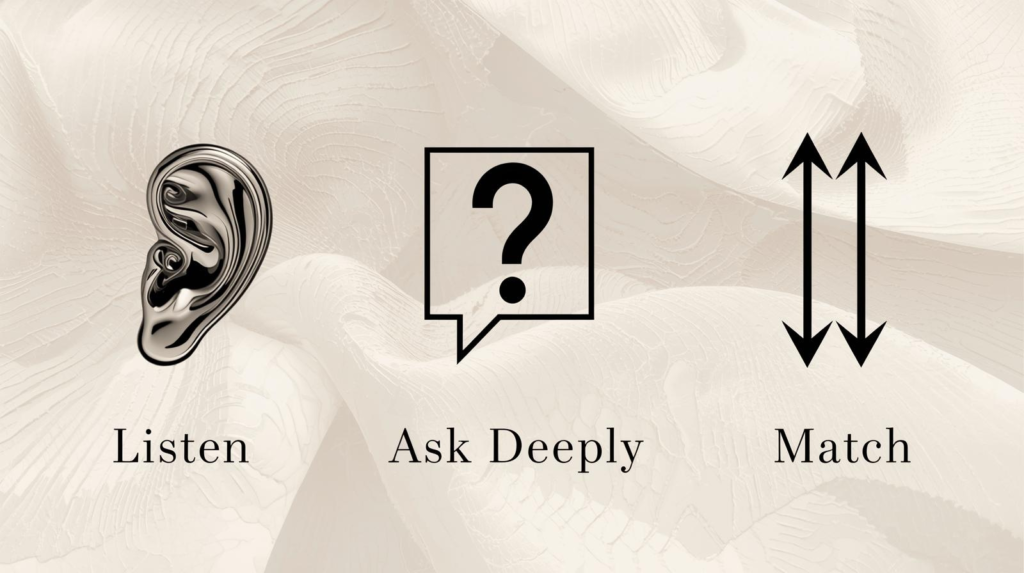
1. PAUSE & DIAGNOSE.
When someone speaks, don’t just hear their words. Ask yourself silently: “Is this about the Head, the Heart, or their Identity?” Listen for clues: facts, feelings, or statements about self.
2. PROBE WITH A DEEP QUESTION.
Use one gentle question to confirm the channel and show you want to understand.
- For Potential Heart Channel: “How are you feeling about all this?”
- For Potential Identity Channel: “What’s your biggest concern here?”
3. MATCH THEIR FREQUENCY.
Join their channel before guiding the talk.
- If they’re on the Heart channel, offer empathy: “That sounds really tough.”
- If they’re on the Identity channel, affirm their value: “It makes sense you’d see it that way, given your role.”
- Once connection is made, you can ask: “Would it be helpful to talk about some practical steps?”
The Challenge That Will Change Your Talks
True knowledge becomes wisdom through practice. This week, conduct a simple experiment.
Have one conversation where you consciously seek the channel.
When a colleague, friend, or family member brings something up, pause. Silently diagnose: Head, Heart, or Identity? Ask one thoughtful, deeper question that seeks meaning, not just facts. Then, match their energy.
You will feel the shift. The static will clear. You will be having the same conversation.
The greatest wisdom in communication is this: People live in different worlds of thought. Your job is not to bring them into your world, but to be a guest in theirs. The key to their world is a question of meaning. Use it wisely.